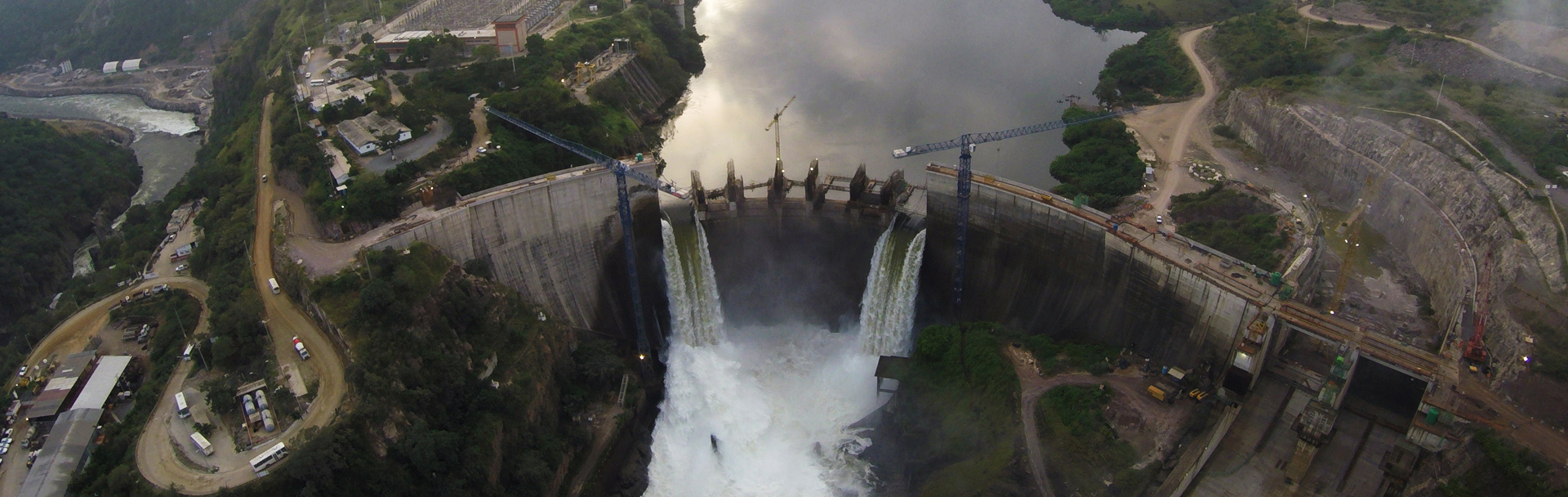
Angola’s hydropower challenge is shifting from installed capacity to dependable performance. The next value pool lies in how existing and near-complete assets are operated, coordinated, maintained, and governed.
This is the operating question at the heart of PARA OS.
PARA OS is an integrated intelligence and operations platform built around a simple principle: complex assets create value when live data, engineering logic, analytics, AI, and operational workflows are connected into a governed decision environment. The Kwanza cascade illustrates why this logic matters beyond buildings and portfolios, especially where infrastructure assets are physically connected and operationally interdependent.
The scale of the Kwanza system is significant. The cascade includes Capanda at 520 MW, Cambambe at 960 MW, Laúca at 2,070 MW, and Caculo Cabaça at 2,172 MW under construction. National installed capacity is estimated at around 5.6 to 5.7 GW, against a policy ambition of 9.9 GW under Angola Energy 2025. RNT data shared in the context of the sector discussion indicates peak utilised capacity of around 2.9 GW. This should not be read as a simple availability ratio. It points to a broader system challenge involving asset availability, transmission capacity, demand patterns, hydrology, dispatch coordination, and operational readiness.
Within Sidara, Dar’s long-standing work in Angola’s power and water sectors provides an engineering reference point for this discussion. On the Kwanza River, Dar contributed to the Cambambe Hydroelectric Power Plant and Dam through design and construction supervision for dam heightening and plant rehabilitation, increasing total installed capacity at Cambambe to 960 MW. Dar has also advised Angola’s 370 MWp solar photovoltaic programme and supported integrated water resource planning in Cunene Province. These engagements provide a practical lens for the digital twin discussion: improving the performance of strategic infrastructure already in place.
For hydropower, a digital twin is most useful when it functions as an operational decision tool, not a visual model. It connects field instrumentation, hydrological models, physics-based simulation, analytics, artificial intelligence, and control room workflows so operators can test scenarios and improve decisions on dispatch, reservoir management, maintenance, and dam safety.
The Kwanza cascade is a strong candidate for this approach because it operates as a connected system. A release decision at one dam affects reservoir storage, power generation, ecological flows, and downstream performance at the next. The hydrological constraint reinforces the need for coordination. The reservoirs of Capanda, Laúca, and Cambambe together hold roughly 7,500 hm³ of live storage, enough to regulate only around one third of an average water year. Mean annual flow is approximately 650 m³/s, but dry-year flows can fall to around 312 m³/s, while peak years can exceed 1,000 m³/s. The World Bank’s Angola Country Climate and Development Report also notes that Angola’s annual mean temperature has increased by 1.4°C since 1951 and that southern Angola has faced its worst drought conditions in 40 years. Under these conditions, operational intelligence becomes a resilience requirement.
A 2025 study conducted by Dar and SuYapı assessed the adoption of digital twins for dam structural integrity and operations. The study identified four priority capability areas: resource management, structural and health monitoring, sustainability compliance, and integrated work management. These areas align directly with the operational needs of large dam systems, where water flow, asset condition, regulatory obligations, and maintenance workflows must be managed together.

For the Kwanza system, the most relevant use cases sit in two domains. The first is operations: AI-supported dispatch, cascade coordination, continuous reservoir scenario planning, and basin-level integration across energy, irrigation, ecological, and water-security requirements. The second is asset integrity: predictive maintenance for turbines and generators, and structural health monitoring for dams and civil structures.
International precedents support this direction. The U.S. Department of Energy’s Digital Twin for Hydropower Systems, developed with Oak Ridge National Laboratory and Pacific Northwest National Laboratory, provides a reference framework for real-time hydropower monitoring, simulation, predictive maintenance, energy optimisation, and ecological modelling. The main barriers are institutional as much as technical. Interoperability, cybersecurity, data ownership, model validation, governance, and operator trust will determine whether digital twins become operational tools or remain isolated pilots. At Laúca, for example, the MIGA Environmental and Social Review Summary refers to a minimum downstream flow of 350 m³/s and an ecological flow of 122 m³/s through the ecological powerhouse. Any optimisation model must treat these constraints as binding operating requirements.
For PARA, the lesson is clear. Complex assets generate value when they are managed as coordinated operating systems rather than isolated sources of data. For Angola’s hydropower sector, that means using digital twins to improve dependable energy and water value from the Kwanza cascade, supported by better planning, stronger maintenance, and more transparent decision-making.